There is a particular kind of organizational risk that never appears on a balance sheet, never triggers a board discussion, and never makes it onto a risk register. It does not arrive suddenly, like a product recall or a regulatory fine. It accumulates quietly, month after month, in the gap between what employees need and what organizations actually provide. It is the cost of doing nothing — and in 2026, that cost has become impossible to ignore.
The Illusion of Stability
When organizations choose not to act on engagement data, not to invest in manager development, not to address burnout signals, or not to redesign how feedback flows through the organization, they rarely experience it as a choice. Inaction feels neutral. It feels like holding steady. The budget is preserved. No change initiative risks failure. No one has to have a difficult conversation about culture.
But the research tells a different story. Organizational inaction is not neutral. It is a decision with consequences — financial, human, and strategic — that compound over time precisely because they are invisible until they become acute.
The Numbers Behind the Silence
Gallup's State of the Global Workplace 2026 report, drawing on surveys across more than 160 countries and nearly 150,000 employed respondents, puts the global cost of employee disengagement at approximately $10 trillion in lost productivity annually — roughly 9% of global GDP. That figure is not the cost of some dramatic organizational failure. It is the cost of the ordinary, accumulated weight of people who are present at work but not genuinely invested in it.
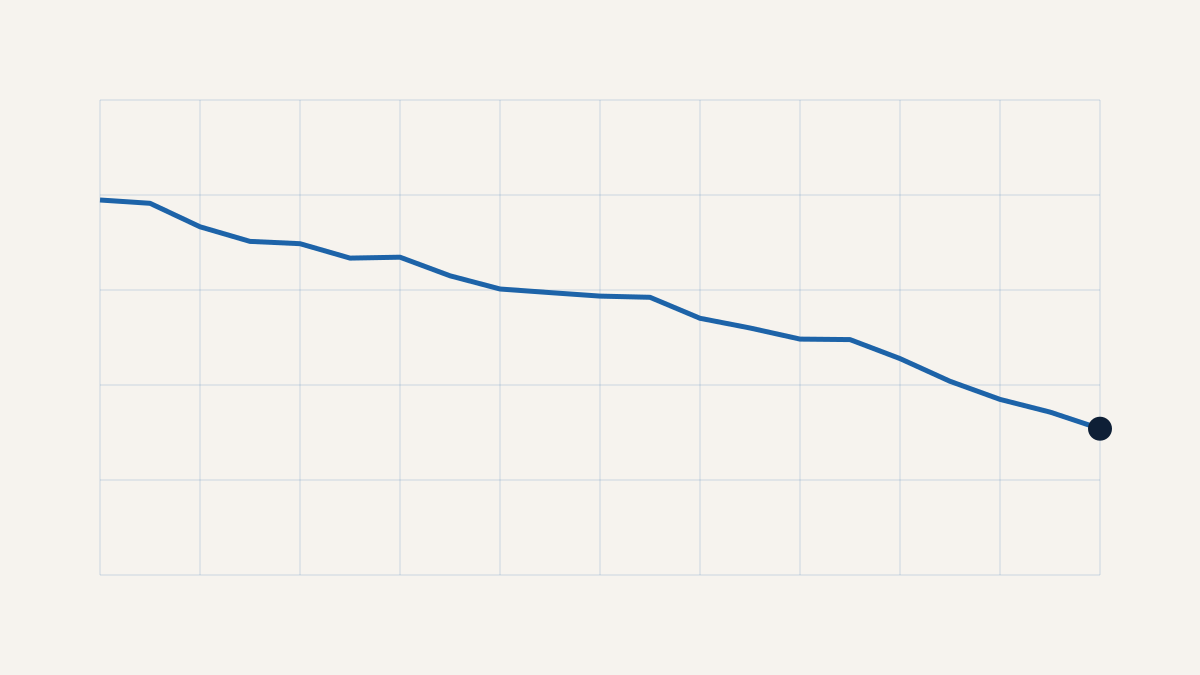
Only 20% of employees worldwide describe themselves as truly engaged — the lowest level since 2020, and the second consecutive year of decline. In Europe, that number falls further, to between 12% and 13%. In the United Kingdom, it reaches a low of just 10%.
These are not outlier organizations struggling with obvious cultural problems. This is the baseline. This is what happens when organizations treat the employee experience as a secondary concern — something to address when the business is doing well, when there is budget available, when things are not too busy.
The data also reveals where the decline is concentrated. Since 2022, manager engagement has fallen by nine percentage points globally, reaching just 22% in 2025. Managers — the people Gallup consistently identifies as accounting for 70% of the variance in team-level engagement — are themselves disengaging faster than the workforce they lead. The layer of the organization most responsible for translating strategy into human experience is quietly running out of the energy required to do so.
What Inaction Costs: Three Dimensions
The cost of organizational inaction is not one number. It moves across at least three dimensions simultaneously, and each amplifies the others.
The productivity dimension is the most visible. Disengaged employees are not absent — they are present, which makes them harder to account for than those who leave. They complete tasks without discretionary effort. They do not innovate. They do not go beyond what is minimally required. Research consistently shows that highly engaged teams outperform their disengaged counterparts by significant margins across quality, customer satisfaction, and output metrics. The gap between an engaged team and a disengaged one is not a marginal performance difference. It is often the difference between a team that drives results and one that simply maintains them.
The retention dimension is more expensive than most organizations calculate. Conservative estimates place the cost of replacing an employee at between 50% and 200% of their annual salary, depending on seniority and specialization. That figure includes recruitment costs, onboarding time, productivity loss during the transition, and the institutional knowledge that walks out the door. What it does not include — and what is harder to price — is the signal that voluntary turnover sends to those who remain. Every resignation is a data point that other employees read carefully. When talented people leave, and organizations respond by saying that engagement scores are a priority for next year's strategy cycle, they are making a statement about what they actually value. The people who stay notice.
The wellbeing dimension carries its own compounding logic. The DHR Global 2026 Workforce Trends Report found that 52% of employees now say burnout actively decreases their engagement — up from 34% just one year ago. Burnout is not a personal resilience failure. It is an organizational output. It is what happens when demand consistently exceeds resources, when recognition is absent, when development feels impossible, and when the relationship between effort and reward breaks down. Left unaddressed, burnout moves from an engagement problem to an absence problem to a health cost — and eventually to a retention crisis, as the people most committed to their work, who pushed hardest and absorbed the most, become the ones most likely to leave.
The Compounding Effect
What makes organizational inaction uniquely costly is not the impact of any single dimension but the way they reinforce each other over time. Disengagement reduces productivity. Reduced productivity increases pressure on the people who remain engaged. Increased pressure accelerates burnout. Burnout drives turnover. Turnover concentrates workload on fewer people. And the cycle continues, each rotation extracting more from the organization than the one before it.
This compounding effect is why organizations that delay investment in the employee experience rarely find that the problem has stayed the same size by the time they return to it. It has grown — quietly, invisibly, in the space that inaction created.
The Opportunity Cost
There is a final dimension to the cost of doing nothing that rarely enters the conversation: what organizations fail to build while they are waiting.
The Gallup 2026 data contains one finding that deserves particular attention. In organizations Gallup classifies as best-practice — those that treat employee engagement as a strategic priority rather than an HR metric — 79% of managers are engaged, nearly four times the global average. These organizations exist across all regions and all industries. They are not defined by sector, size, or geography. They are defined by a decision: to treat the human dimension of organizational performance as something that requires the same deliberate investment as any other strategic capability.
The gap between those organizations and the rest is not luck. It is not culture as something inherited. It is the accumulated result of choices — to develop managers, to listen systematically, to act on feedback, to create conditions in which people can do their best work. None of those choices are complicated in concept. All of them require sustained commitment in practice.
The organizations that make those choices now are not just avoiding the cost of doing nothing. They are building a compounding advantage that their competitors — who are also waiting for a better time — will find increasingly difficult to close.
A Practical Starting Point
For organizations that recognize themselves in this data, the question is not whether to act. The question is where to begin. The research points consistently toward three levers that carry disproportionate impact relative to their investment:
Invest in managers first. Not as a leadership development line item, but as an organizational priority. Managers need development, support, appropriate spans of control, and the explicit message that their own engagement matters — not just as a means to team performance, but as an end in its own right.
Listen before you build. Many organizations invest in wellbeing programs, engagement initiatives, and culture change efforts before they have systematically understood what their own employees actually need. Listening — real, structured, acted-upon listening — is not a precursor to the work. It is the work.
Make development visible and personal. Across the DHR Global 2026 data, professional development remains the single strongest driver of employee engagement, cited by 71% of employees. Not perks, not policies, not platforms — the concrete sense that the organization is invested in where each person is going. That does not require a large budget. It requires intention.
Conclusion
The cost of doing nothing is real, measurable, and growing. It shows up in productivity gaps, in turnover rates, in absence data, in healthcare costs, and in the quiet erosion of the discretionary effort that separates organizations that merely function from those that genuinely perform.
In 2026, the organizations that will build lasting competitive advantage are not necessarily those with the most sophisticated technology or the most ambitious transformation agenda. They are the ones that understand a simpler truth: that people who feel seen, supported, and developed do better work — and that creating those conditions is not a soft priority. It is a strategic one.
The cost of doing nothing is a choice. So is the alternative.